St. Petersburg’s Artistic Soul Lives in Its Mind-Blowing Architecture
You know that feeling when a city just hits different? For me, it was St. Petersburg—where every building feels like a brushstroke on a giant canvas. I never expected architecture to move me, but here, palaces whisper history and churches explode with color. This isn’t just stone and paint; it’s art you can walk through. Let me show you why the city’s buildings aren’t just structures—they’re masterpieces. From golden domes rising above the Neva River to pastel-colored palaces reflecting in quiet canals, St. Petersburg unfolds like a carefully composed painting. It’s a place where design and destiny intertwine, where rulers once shaped skylines to reflect their vision of empire, and where today’s travelers can step into centuries of artistic ambition made tangible.
The City as a Living Art Gallery
St. Petersburg is not merely a city—it is an open-air museum, a vast urban canvas where architecture becomes the primary language of expression. Founded by Peter the Great in 1703, the city was conceived as Russia’s “window to Europe,” and its very layout was a deliberate artistic statement. Unlike older cities that evolved organically, St. Petersburg was master-planned with symmetry, proportion, and grandeur in mind. Wide avenues radiate from central squares, canals mimic those of Venice, and the Neva River serves as a liquid boulevard lined with monumental facades. Every bridge, column, and cornice contributes to a cohesive aesthetic that transforms daily life into a continuous encounter with beauty.
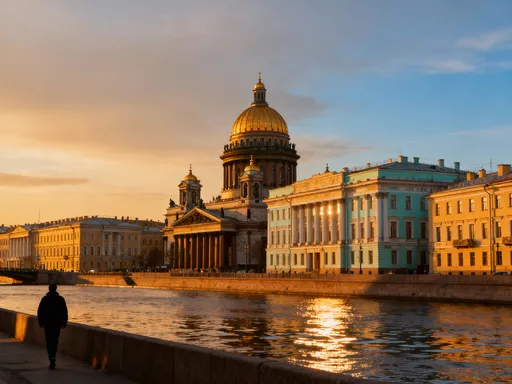
The Historic Center, now a UNESCO World Heritage Site, exemplifies this architectural harmony. Here, buildings do not simply coexist—they converse. Baroque, Neoclassical, and Empire styles stand side by side, each era adding its voice to a centuries-long dialogue. The embankments of the Neva River are particularly striking, where palatial facades stretch for blocks, their pastel hues glowing in the soft northern light. The granite and marble walls seem to absorb the sky, shifting from silver at dawn to gold at sunset. Walking along these banks, one doesn’t just see architecture; one feels enveloped by it, as if moving through a living gallery curated by time itself.
What sets St. Petersburg apart is how its urban design elevates aesthetics over mere utility. Streets were engineered not only for transport but for spectacle. Perspective views were carefully calculated so that key landmarks—like the spire of the Admiralty or the golden dome of St. Isaac’s Cathedral—would appear at the end of long avenues, creating dramatic visual anchors. This attention to composition reveals a deep understanding of how space influences emotion. Even today, standing at the start of Nevsky Prospekt and seeing the distant silhouette of the Kazan Cathedral, visitors experience a sense of anticipation akin to the opening act of a grand performance. The city doesn’t just display art—it performs it through its very structure.
The Winter Palace & The Hermitage: Power Painted in Stone
No building in St. Petersburg embodies the fusion of political power and artistic mastery more completely than the Winter Palace. Completed in 1762 under Empress Elizabeth, this vast Baroque masterpiece was designed by Italian architect Bartolomeo Rastrelli to project imperial might through sheer visual splendor. Stretching over 200 meters along the Palace Embankment, its green-and-white façade is adorned with ornate columns, sculpted pilasters, and gilded details that shimmer in the sunlight. The exterior alone communicates a message: here resides a ruler whose authority is matched only by their taste.
Inside, the effect is even more overwhelming. The Jordan Staircase, also known as the Ambassador’s Staircase, rises with theatrical grandeur, its white marble steps flanked by classical statues and bathed in natural light from a skylight above. Each room unfolds like a chapter in a story of opulence—Malachite Room with its semi-precious stone walls, the Pavilion Hall with its intricate mosaic floor, and the Great Throne Room, where gold leaf and crimson velvet create an atmosphere of divine right. These spaces were not built for comfort but for impact, designed to humble visitors and reinforce the emperor’s status as both ruler and patron of the arts.
Today, the Winter Palace houses the core of the State Hermitage Museum, one of the largest and most important art collections in the world. The building itself enhances the experience of viewing art, as galleries flow seamlessly from one ornate space to another. Visitors don’t simply walk through exhibitions—they move through layers of history, where the architecture frames the masterpieces both literally and symbolically. A painting by Rembrandt gains depth when viewed beneath a painted ceiling depicting celestial glory; a sculpture by Canova feels even more divine when displayed in a hall designed to evoke ancient Rome. In this way, the palace does not compete with the art—it elevates it, proving that architecture can be both container and collaborator in the artistic experience.
Churches That Defy Imagination: St. Isaac’s and the Smolny
Religious architecture in St. Petersburg transcends function to become pure visual poetry. Among the most awe-inspiring is St. Isaac’s Cathedral, a monumental tribute to engineering and artistry. Its golden dome, made from nearly 100 kilograms of gold, dominates the city skyline and can be seen from miles away. Completed in 1858 after 40 years of construction, the cathedral required the labor of over 400,000 workers and the innovation of new techniques to support its massive granite columns and copper-clad dome. Inside, the effect is breathtaking: walls covered in malachite, lapis lazuli, and porphyry; frescoes stretching across vaulted ceilings; and a colonnade that seems to hold up the heavens.
What makes St. Isaac’s truly remarkable is how it blends spiritual symbolism with artistic ambition. The interior columns, often mistaken for marble, are actually made of monolithic granite, each weighing up to 114 tons and transported from distant quarries by specially designed barges. The floor features intricate patterns created from natural stones, and the dome’s interior is painted to depict scenes from the life of St. Isaac of Dalmatia, illuminated by sunlight filtering through hidden windows. Visitors often report a sense of quiet awe—not just from the religious iconography, but from the sheer scale of human creativity on display. It’s a space where faith and artistry are inseparable, each reinforcing the other.
In contrast, the Smolny Convent offers a softer, more lyrical expression of sacred beauty. Designed by Italian architect Giacomo Quarenghi in the early 19th century, its pale blue and white façade with delicate colonnades exudes elegance and serenity. The central dome, topped with a golden cross, rises gently above the surrounding trees, creating a harmonious silhouette against the sky. Originally built as a convent and educational institution for noblewomen, Smolny reflects Enlightenment ideals—order, grace, and intellectual refinement. Though no longer an active convent, its grounds remain a place of quiet contemplation, where the architecture invites reflection rather than spectacle. Together, St. Isaac’s and Smolny represent two sides of St. Petersburg’s spiritual architecture: one bold and triumphant, the other gentle and introspective, yet both undeniably artistic.
Hidden Gems: Lesser-Known Buildings With Big Personality
While the grand landmarks draw the crowds, some of St. Petersburg’s most enchanting architecture lies off the beaten path. The Church of the Savior on Spilled Blood is perhaps the most famous of these hidden treasures, yet it often surprises visitors with its intensity. Built on the site where Emperor Alexander II was assassinated in 1881, the church is a riot of color and pattern, its onion domes tiled in intricate mosaics that shift in hue depending on the light. Inspired by 17th-century Russian Orthodox design, particularly the iconic St. Basil’s in Moscow, the church stands as a monument to national identity expressed through art. Inside, over 7,500 square meters of mosaic cover walls and ceilings, depicting biblical scenes with astonishing detail. Unlike the more restrained imperial buildings, this church feels deeply emotional—a cry in stone and glass.
Another overlooked gem is the collection of Art Nouveau townhouses along Liteyny Prospekt and the side streets near the Fontanka River. These early 20th-century buildings feature flowing lines, floral ironwork, stained glass, and sculpted faces peering from façades. Architects like Fyodor Lidval and Marian Peretyatkovich pushed creative boundaries during a brief flowering of modernist design before the Revolution. One notable example is the Lidval House, once a luxury hotel, where sinuous balconies and ceramic tiles create a sense of movement, as if the building itself is breathing. These structures offer a quieter, more personal kind of beauty—one that rewards slow observation and curiosity.
For travelers seeking authentic encounters without the throngs, timing and route planning make all the difference. Early mornings or late afternoons offer softer light and fewer people, especially at popular sites like the Savior on Spilled Blood. Venturing into neighborhoods like Petrogradskaya Side or along the Kryukov Canal reveals residential courtyards and lesser-known palaces tucked behind unassuming gates. Using local walking maps or audio guides focused on architecture can help uncover these stories. Even a simple detour down a narrow street might lead to a forgotten fountain, a sculpted doorway, or a rooftop adorned with mythological figures. In St. Petersburg, beauty isn’t confined to postcard views—it’s embedded in the everyday fabric of the city.
How Design Tells Russia’s Story
The architecture of St. Petersburg is more than decorative—it is a chronicle of a nation’s evolving identity. Each era has left its mark, layering meaning onto the cityscape. The 18th-century imperial buildings reflect Peter the Great’s ambition to modernize Russia and align it with European powers. The Neoclassical structures of the late 18th and early 19th centuries, such as the General Staff Building and the Kazan Cathedral, echo the ideals of reason and order, inspired by ancient Greece and Rome. These designs were not just fashionable—they were ideological, asserting Russia’s place among the enlightened civilizations of the world.
The Soviet period introduced a stark contrast. While many historic buildings were preserved—often through heroic efforts by local architects and citizens—new constructions favored utilitarian forms. Constructivist buildings, with their geometric shapes and industrial materials, appeared in districts like the Smolninskoye, reflecting a shift toward collectivism and functionality. Yet even during this time, the city’s artistic legacy was never fully erased. Some Soviet-era buildings incorporated classical elements subtly, suggesting a quiet continuity. Moreover, the preservation of landmarks like the Winter Palace and St. Isaac’s Cathedral during decades of political upheaval speaks to a deep cultural reverence for artistic heritage.
In recent decades, restoration has become a national priority. After suffering damage during World War II and years of neglect, many buildings have been meticulously rebuilt using original plans and traditional techniques. The Royal Palace at Peterhof, located just outside the city, stands as a powerful example. Though looted and burned by German forces in 1941, it has been restored to its former glory, with gilded statues, cascading fountains, and frescoed halls once again welcoming visitors. This commitment to renewal is not about erasing history but honoring it—proving that beauty, once created, is worth fighting for. In St. Petersburg, architecture is not static; it is a living record of resilience, adaptation, and enduring pride.
Practical Magic: Planning Your Art-Focused Visit
To truly appreciate St. Petersburg’s architectural wonders, a thoughtful approach to planning can make all the difference. The best time to visit is between May and September, when the so-called “White Nights” extend daylight into the early morning hours, offering soft, golden light ideal for photography. During this period, the city’s facades glow in the twilight, and evening strolls along the canals become unforgettable experiences. Spring and early autumn also bring fewer tourists, allowing for quieter contemplation of major sites without long lines or crowded viewpoints.
Walking is the most rewarding way to explore. A well-designed route can link key landmarks while revealing hidden corners. Begin at Palace Square, home to the Winter Palace and the Alexander Column, then proceed down Nevsky Prospekt, noting architectural details like ornate doorways, sculpted balconies, and historic shop fronts. Turn onto the Moika River embankment to see the opulent Yusupov Palace, then cross to St. Isaac’s Cathedral for panoramic views from its colonnade. A boat tour along the Neva and its canals offers a unique perspective, showing how the city’s buildings interact with water and sky. Many local companies provide architecture-focused cruises with commentary on design history.
For deeper insight, consider guided tours led by art historians or architects. These specialized walks often access restricted areas or share stories not found in guidebooks—such as the symbolism behind certain façade carvings or the engineering behind massive domes. The Hermitage offers themed tours on palace architecture, while independent groups organize visits to Art Nouveau districts and restored courtyards. Public transportation is efficient, with metro stations themselves serving as underground works of art, adorned with chandeliers, mosaics, and marble columns. Most major landmarks are wheelchair accessible, though some older buildings may have limited elevators or uneven floors. Carrying a detailed map or using a reliable navigation app ensures you won’t miss quieter streets where architectural surprises await.
Why This Journey Changes How You See Art
Visiting St. Petersburg does more than fill a camera roll—it reshapes the way one understands art itself. In most cities, museums are where art lives, contained within frames and behind glass. But here, art escapes the gallery. It climbs the walls of palaces, crowns the skyline with golden domes, and flows through the very streets. The experience teaches a profound lesson: that beauty is not separate from life but woven into its structure. A doorway is not just an entrance; it is a statement. A staircase is not just a path; it is a performance. Architecture, in this city, is not background—it is the main character.
This shift in perception lingers long after the trip ends. Back home, one begins to notice details previously overlooked—the curve of a wrought-iron railing, the pattern of bricks on a façade, the way light falls on a building at dusk. St. Petersburg instills a new sensitivity, a habit of seeing the artistic intention behind every constructed space. It reminds us that cities are not just places to live, but canvases shaped by generations of visionaries, craftsmen, and dreamers. The care taken in a carved capital or a painted ceiling reflects a belief that beauty matters—that it uplifts the spirit and dignifies daily life.
Ultimately, the journey through St. Petersburg’s architectural landscape is an invitation to look deeper. It asks us to move beyond surface sightseeing and engage with the stories embedded in stone and steel. It challenges the notion that art is rare or reserved for experts, showing instead that it can be found in the shape of a spire, the color of a wall, the rhythm of a colonnade. To walk its streets is to participate in a centuries-old conversation between creator and observer, between past and present. And in that exchange, we discover that the greatest masterpieces are not always hung on walls—they are the walls themselves, standing as silent, magnificent testaments to what human hands and hearts can achieve.